suburbia
notes from the maze of convenience

What birds plunge through is not the intimate space
in which you see all forms intensified.
(Out in the Open, you would be denied
your self and disappear into that vastness.)
Space reaches from us and construes the world.To know a tree, in its true element,
throw inner space around it, from the pure
abundance in you. Surround it with restraint.
It has no limits. Not till it is held
in our renouncing is it truly there.
— Rainer Maria Rilke, translated by Stephen Mitchell
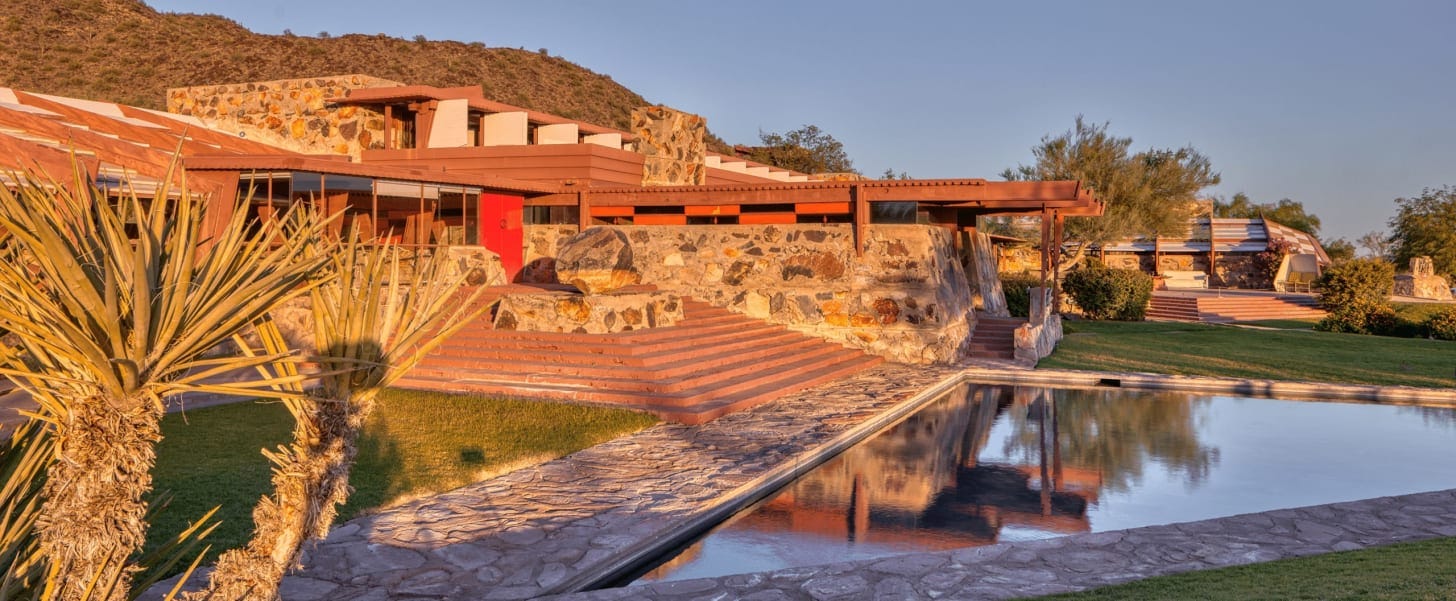
For a few months every summer, the desert suburb my parents and I called home would get so hot that “taking a walk” involved a 20-minute drive to the nearest mall or Costco. In the twelve years I spent there as a child, I learned that the desert mirage isn’t an invention of the cinema. Growing up in Scottsdale is an exercise in learning to see heat: not the heat of thermometers or weather apps, but the kind that bends — a shimmering veil over strip-mall parking lots, a liquid glaze on the hoods of idle cars.
Our first house sat on the corner of a grid-plot neighborhood, perfectly positioned so that I could sit on a couch by the front window and watch the cars pass by. This neighborhood was part of a meticulously planned post-war expansion, one of countless subdivisions that transformed what was once a small farming town into a sprawling suburb that would eventually exceed 240,000 residents. The only “place to be” within miles was the tennis center across the street, where I’d spend evenings after school and long, torrid summer afternoons whacking balls back and forth on courts nestled in valleys of grass.1 I could have crossed the street and walked there, if the thought of walking somewhere had ever occurred to me, but we always drove.
Suburban Arizona is a study in paradox. Its streets bear names like “Whispering Wind” and “Sunset Pass,” though the wind doesn’t whisper — it rasps and howls, carrying the scent of sunbaked asphalt — and the sun doesn’t set so much as expire, collapsing behind the McDowell Mountains in a blaze of theatrics. The grid layout, so rational from a planner’s desk, becomes a labyrinth when you’re 9 and trying to bike to your friend’s house 1.2 miles away, a journey requiring the navigation of six arterial roads with no sidewalks, three dead-ends, and a drainage ditch that might as well be the River Styx.2
If Scottsdale embodied horizontal emptiness, Phoenix offered its vertical variant — buildings rose from the desert floor like mirages solidified, yet maintained polite distance from each other as if respecting an unspoken desert etiquette. The “city” — central Phoenix — didn’t exist until high school, when by way of my friend Ted I discovered a coffee shop called Lux Central with its gregarious baristas and talented baker and speakeasy-like interior. Half a century earlier, in the decades following the 1960s, Central Avenue would see a concentration of nightlife and civic events as Phoenix experienced spectacular growth. Even in “central” Phoenix, though, I experienced space and distance not too differently from the way I did in Scottsdale. I would drive 30 minutes from home to sit in a room meant for foot traffic, trading fossil fuels and time for proximity.
College offered a lateral move into another subspecies of suburb: Claremont, California, a town whose entire identity orbits the five liberal arts colleges planted there like orchids in a parking lot. Arizona’s sprawl felt like a spreadsheet, but Claremont was a Venn diagram: overlapping circles of academia, twee downtown boutiques, and streets named after East Coast colleges to lend unearned gravitas. Harvey Mudd’s campus felt like an engineer’s fever dream: everything was rectangular, brutalist, concrete — a built environment that insisted on precision and order while housing the beautiful chaos of learning. A perfect environment for intellectual squirming.
From 2021, I’d spend more than three years of my life in Mountain View. Part of Santa Clara Valley, once a center of apricot production and home to many orchards, the town is now a landscape of corporate campuses and housing developments — a different kind of suburban expanse from Arizona’s, but governed by similar principles of separation. In Scottsdale, the world looked like a network of roads and highways pockmarked with little enclosures that tried to call themselves communities: “Scottsdale Quarter” and “Kierland Commons” sat across from one another on Scottsdale Rd, offering their visitors a menu of restaurants, shops, and courtyards. Santa Clara’s Santana Row and Westfield Valley Fair were San Jose’s variation on that pairing: a massive indoor mall and a massive outdoor mall separated by a street but connected by the same brands and the same shoppers. With their size and intentional density, these spaces felt odd to me — not alienating so much as ambiguous. I inhabited them much as everyone else did, often transiently.
For me, spatial emptiness became a kind of existential grammar. Suburbs are built on what urban theorist Marc Augé called “non-places” — transitional zones with a different social physics: highways, parking lots, and commercial centers where traditional community markers are replaced by more temporary interactions. In Scottsdale, even our “town square” was a mall — Kierland Commons, with its contemporary facades and curved lampposts illuminating spotless walkways. Between perfectly spaced palm trees I found curated urbanity — a space designed for comfort and convenience, but one where I depended entirely on my parents for access. You could buy a $7 latte there, but not a sense of belonging.
After more than a decade in Scottsdale, I’d yet to visit one of its most famous landmarks. Frank Lloyd Wright’s Taliesin West, squatting in the foothills north of Scottsdale, was designed to marry the land, to exist as if “Nature had intended for it to be there.” This desert compound first existed as Wright’s and his student’s “winter camp,” constructed with local materials, built low to the earth with angles that mimic the sharp, angular lines of the McDowell Mountains. But Taliesin’s harmony is a mirage — the desert doesn’t marry; it tolerates. Though, to me, Wright made as good-faith an effort as anyone could to find consonance with the Arizonan nature, his building — any building in this setting — imposes a distinctly human ordering on desert space. Architecture, like language, cannot render to us the world as it is.
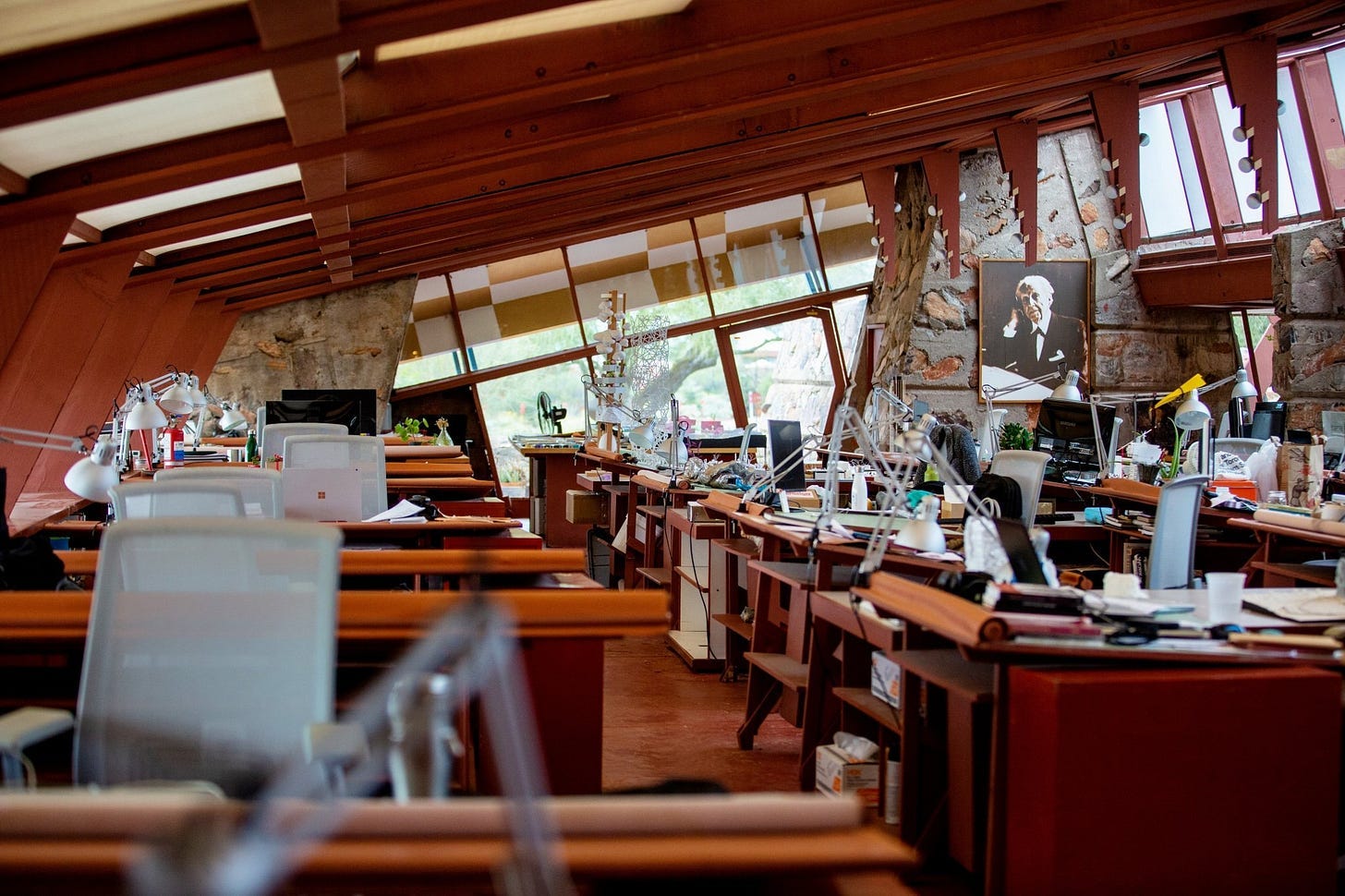
In The Poetics of Space, Gaston Bachelard argued that “intimate immensity” emerges in places that balance shelter and horizon. Suburbs invert this. Their immensity is vast but inert — horizons without revelation, shelter without intimacy. Taliesin West’s drafting studio, with its pitched roof and open sides, attempts to bridge this divide. But when I visited, the space felt like a theater set where the desert served as both backdrop and unwilling participant. Tourists could wander through like spectators at a performance, admiring Wright’s architectural vision but unable to participate in it.
But there’s a reason the desert blooms after monsoons.3 In Scottsdale, change happened with unsentimental efficiency. In 2019, the tennis courts of my youth were erased to make way for the newest branch of Mountainside Fitness — if tennis is a communion between opponents, the “fitness center” is instead home to solitary devotion.4 If these new entrants to the ground of my childhood tried to assert their belonging through their names, those names would only ever serve to reinforce their double non-existence to me, as places impossible both in substance and in idea. This physical erasure, though, granted my memories a peculiar freedom: the asphalt and grass and their inhabitants could exist more vividly for me because they had no referent.
Wright believed that “space is the breath of art.” If so, suburbs are holding their breath — suspended between the exhale of urban density and the inhalation of nature. Suburban planning itself exists in this liminal space, what urban theorists recognize as a deliberate in-between: not the mixed-use vitality of urban communities, nor the productive expanses of rural landscapes, but something with elements of both yet fully neither. I’ve spent most of my life in that suspended moment, watching heat ripple over pavement and measuring distance in drive-times rather than footsteps. As I prepare to leave another suburban chapter behind, I wonder if these places have prepared me not for city life but for understanding the spaces between it and the open landscape — those transitional zones where so much of living actually happens. Not in arrival or departure, but in the journey between, where air fills the lungs and possibilities remain open.
(P.S.: I’ve moved to San Francisco — if you think we’d get along or if we haven’t seen each other in a while do send me a note, I’d love to make new friends!)
I developed a good forehand on those courts, one I would discover years later (when I switched to a racket with better control) drew its power from not the strength of my arm but the intuitive rhythm I’d developed with my racket’s length and large face
to be clear, unlike the children in Helsinki who start biking to school at 5, I rarely if ever did this. I did, however, scooter (?) to a friend’s place, I think, in elementary school; lose my control as I biked down a steep sidewalk in a park and scrape my knee against pavement; fall off a scooter and fracture my wrist and, the next day, learn that most of my classmates believed I’d been injured by falling on a Lego set
Terrance Hayes, in “Lighthead’s Guide to the Galaxy”: All species have a notion of emptiness, and yet / the flowers don’t quit opening.
that Mountainside Fitness is perhaps the site of one of my most memorable experiences at a commercial gym: watching a man pace around with a book in his hand between sets on the bench press
This rocks, also Rilke rocks
> Suburban Arizona is a study in paradox. Its streets bear names like “Whispering Wind” and “Sunset Pass,” though the wind doesn’t whisper — it rasps and howls, carrying the scent of sunbaked asphalt — and the sun doesn’t set so much as expire, collapsing behind McDowell Range in a blaze of theatrics.
love this